Thursday, June 12, 2008

HELL ROADS


Spain promised "zero tolerance" for violence by striking truckers after police cleared picket lines blocking highways during a fuel protest. The government said deliveries of food and other goods were returning to normal on Thursday after an agreement with most of the strikers although food distribution centers reported shortages and car factories remained at a standstill.

"The government is going to have zero tolerance for any act of intimidation or violence," said Socialist Prime Minister Jose Luis Rodriguez Zapatero, after incidents including an arson attack on a strike-breaking truck that left the driver with burns to 25 percent of his body.

The government said it had arrested 71 picketers for offences including intimidating non-striking drivers since the stoppage by 75,000 truckers began on Sunday night to call for government help to cope with high fuel prices.

However the scene at Madrid's main food market, Mercamadrid, which supplies the capital's shops and supermarkets, was far from normal on Thursday as the number of deliveries was reduced to a trickle because non-striking truckers were still being stopped by picketers.

Car plants were also at a standstill, due to a shortage of parts caused by the strike, national car makers' association Anfac said.

In one incident, a driver working for a company which is not participating in the strike suffered burns to a quarter of his body after someone set his truck alight as he slept near where he had been trapped by a picket line.

With fishermen already on strike and Madrid taxi drivers due to stop working for 24 hours from Friday, Spain is being hit hard by the protests caused by surging oil prices, which have spread elsewhere in Europe.


Spain's economy is already reeling from the global credit crunch and the collapse of a housing boom. Economic growth fell to 0.3 percent in the first quarter from 0.8 percent in the last three months of 2007, while inflation hit 4.6 percent in May.


Zapatero has been criticized by media and the conservative opposition for failing to do more to confront the strike and the economic slowdown.
On Monday, tens of thousands of Spanish truck-drivers went on strike to protest high fuel prices and by Tuesday the escalating stoppage began severing the nation’s supply lines to supermarkets, gas stations and even small cafeterias.


In many parts of the country, Spaniards felt the pinch in different ways. Nearly half of the gasoline stations in the northern province of Catalonia were out of fuel as of Tuesday morning, and the regional government sent out an emergency convoy of 20 trucks to replenish their tanks.

Around major cities, traffic continued Tuesday to crawl behind the so-called “snail protests” of slow-moving trucks.


Television news reports showed ships in the Balearic Islands marooned in port for lack of fuel and cargo. In the northern province of Galicia and southern ports of Andalucía, the truckers’ strike, coupled with a fishing strike, left docks and fish stalls barren. Wholesale markets were surrounded by protesters. And shoppers were hoarding staples.


So far the administration of Prime Minister José Luis Rodríguez Zapatero has offered a package of measures to ease the impact of higher fuel prices on small businesses, including lower social security contributions and 55 million euros in subsidies to older truckers who choose to abandon the industry. But Mr. Somoza said the truckers consider these measures insufficient.

They are seeking government regulations guaranteeing a minimum price for their services, above fuel costs.


Tuesday, June 10, 2008

NO OIL, NO TRAVEL

Gas stations in Madrid and the northeastern Catalonia region began running out of fuel Monday as an indefinite strike by truckers began to bite.

The protest over soaring fuel costs began at midnight Sunday.

Antonio Onieva, president of Madrid's station owners organization, told reporters that by 5:30 p.m., 15 percent of the capital's outlets had run out of fuel. Manuel Amado, president of Catalonia's owners' federation, said 40 percent of Catalonia's 1,714 stations had sold out.

The stoppage led to lengthy lines at many gasoline stations across the country as drivers rushed to fill up.

Drivers were paying the equivalent of about $7.32 per gallon of diesel Monday. By contrast, diesel was selling in the U.S. for about $4.75.
Truckers also blocked a number of roads around the country, including some leading into the center of Barcelona and the international border with France.
"We are the ones who move the goods that this country needs to keep working. If we stop because we haven't got the money to buy fuel then the country will stop," Julio Villascusa, president of the transport association Fenadismer, told Cadena SER radio.

Fenadismer representatives and Development Ministry officials met Monday but failed to reach agreement, stretching the strike to a second day.
Fenadismer said more than 90,000 drivers have been called to take part in the strike.

The strike was not expected to have a major effect on city food markets until later in the week.

There was almost no movement of trucks early Monday at Mercamadrid, the main wholesale food market for the Spanish capital.

Development Ministry transport chief Juan Miguel Sanchez said the government will guarantee market supplies.

Fenadismer representatives and Development Ministry officials met Monday but failed to reach agreement, stretching the strike to a second day.

A strike by fishermen across Spain also protesting fuel costs has entered a second week. News reports said smaller boats that fish closer to the coast had now joined the protest, which began May 30.

The stoppages are part of Europe-wide protests against rising prices.

Trucks deliberately slowing down to snail's pace clogged the highways around Spain's main cities Tuesday, the second day of a nationwide strike over rising fuel costs.

Some gasoline stations in Madrid and the northeastern Catalonia region were out of fuel, and there were fears that supermarket could also be affected.

Traffic to and from Madrid, Barcelona, Seville, Alicante and other cities was backed up behind trucks, the Interior Ministry's traffic division said. Trucks also blocked the Junquera border crossing with France for a second day, allowing only cars to get through.

The ministry opened up three toll roads to try to ease access to Madrid.
The striking truckers -- many of whom are independent and self-employed -- are demanding minimum, guaranteed haulage rates to offset rising fuel prices and enable them to compete with large trucking companies.

The government was meeting for a second day of talks Tuesday with the truckers' representatives. But it has said that setting guaranteed rates would violate the principle of free market competition.
The strike is the most serious labor unrest that has faced Prime Minister Jose Luis Rodriguez Zapatero since he came to power in March 2004. Spanish fishermen also have been on strike since May 30 to protest rising fuel costs.
Spain is struggling with an economic slowdown after a decade-long boom in the real estate sector came to a halt.
Meanwhile, a similar truckers' protest was taking place in Hong Kong, with truck drivers in a go-slow strike to disrupt traffic and protest rising fuel costs.
About 300 marched to Hong Kong's government headquarters and demanded that fuel taxes be slashed, according to government-run broadcaster RTHK.
Light, sweet crude for July delivery was at $134.04 a barrel Tuesday in Singapore.

Spanish truck drivers began a blockade of their country’s border with France on Monday, lining up their rigs and slowing them to a crawl to protest the cost of diesel fuel. The strike blocked the highway in both directions in southwestern France. But the Spanish drivers were not the only ones feeling the price pinch. French drivers slowed traffic near Bordeaux to demand lower fuel prices, offering a foretaste of a national strike planned by French truckers next Monday. Portuguese drivers blocked roads, and in Liège, Belgium, thousands of labor union members demonstrated to protest the rising cost of living as a result of higher fuel costs.


Fuel prices have been far higher in Europe than in the United States for many years, largely as a result of fuel taxes. Taxes account for at least half the price that motorists pay and sometimes more than 70 percent.
But the sustained surge in oil prices has left many Europeans bewildered by the relentless increase in the cost of fuel. Depending on where and how it is bought, the price of diesel — widely used in private cars as well as by truckers, fishermen and farmers — can reach the equivalent of almost $9 per gallon.
Across Spain, about 70,000 truckers joined the strike Monday, according to Desirée Paseiro, a representative of a truckers’ association that is threatening to paralyze the country unless the government introduces measures to lower fuel bills.
The strike has alarmed many people, who already have begun lining up at gas stations and supermarkets for fear that supplies will be cut. Wholesale food markets like Mercamadrid stocked up on fish and meat over the weekend so their stalls would not be left bare.
On Monday morning, groups of slow-moving trucks blocked the major highways that surround Madrid in a so-called snail protest that snarled traffic. Some food distributors fear that their trucks will not be allowed to roll.
“We are the ones who move the merchandise that this country needs to function,” Julio Villascusa, a truckers’ representative, told the Cadena Ser radio station on the eve of the strike. “If we don’t have the money to keep buying fuel to offer this public service, well, then, this country comes to a halt.”
Spanish truckers say the price of diesel, which varies among European countries, was the equivalent of $7.73 per gallon, compared with $5.58 per gallon a year ago. At that price, they argue, it costs them more to buy fuel than they earn from trucking contracts.
Prices at the pump could continue to climb, according to Jeffrey Currie, the global chief of commodities research at Goldman Sachs. At an oil and gas conference in Malaysia on Monday, he said that oil prices were likely to hit $150 a barrel this summer, surpassing the record of $139.12 set last Friday, Reuters reported.
Spain has been particularly hard hit as soaring fuel prices coincide with the sharpest economic retreat in 15 years. The Spanish government has so far offered loans to the industry, composed principally of small businesses. Tens of thousands of truckers in Spain, France and Portugal on Monday stepped up protests against rising fuel prices, causing mayhem on highways and blocking border crossings. Huge tailbacks built up around major cities and on the French-Spanish border as French fishermen in Mediterranean ports ended their three-week strike over the spiralling cost of fuel.
Spain's second largest hauliers' union Fenadismer, which claims to represent 70,000 out of Spain's 380,000 truck drivers, launched an open-ended strike on Monday. It said it was "peaceful" but followed "massively".
Talks Monday between the hauliers and the government ended in failure, Fenadismer said.
"Fenadismer will maintain its national strike" as the government's proposals were "insufficient", it said.
Trucks jammed several main highways including at the frontier with France, according to traffic officials, who also reported massive snarls in Madrid and Valencia.
A Spanish truckers' group calling itself the Platform for the Defence of the Transport Sector, who say they speak for 50,000 truckers, walked off the job last week. They have threatened to disrupt the opening this weekend of the International Exposition in Zaragosa.
The conservative Spanish newspaper ABC said the aim of the strikers was to block oil supplies from refineries and stocks at retail markets this week.
Spanish media said the number of trucks at wholesale markets on Monday were considerably lower than usual.
French truckers struggling with high fuel costs staged fresh protests near the Spanish border and in the southwest.
Several trucks from the southern city of Perpignan disrupted traffic at border posts, preventing trucks from crossing and causing a tailback of some 10 kilometres (six miles) on both sides of the border. Private cars were allowed through.
Protestors branded banners which read: "Trucker = Unemployed," and "It's the end of our profession."
Some 200 trucks converged on the four main motorways leading into Bordeaux Monday morning, causing 30 kilometers (20 miles) of tailbacks in and around the city.
"We are demanding immediate measures" to counter the impact of high fuel prices, said Jean-Pierre Morlin, president of the European trucking organisation for the Aquitaine region.
Portugal's Transport Minister Mario Lino was to meet later Monday with representatives of road transport associations in a bid to end the strike by truckers who have threatened to "paralyze" the country.
According to police, trucks parked at petrol pumps were stoned overnight or while they were on the road after the strike started at midnight.
Many had their windscreens shattered.
The strikers also blocked entrances to several factories. According to industry figures, there are some 40,000 truckers in Portugal serving an estimated 5,000 firms.
However, French fishermen from Mediterranean ports on Monday ended a three-week strike ahead of a key meeting of European fisheries ministers.
"All of the fleets from the Mediterranean ports went back to work this morning, but we remain very vigilant," said Ange Natoli, a representative of the Mediterranean fishing fleets.
Fleets in the Channel ports of Boulogne-sur-Mer, Calais and Dunkirk last week called off their strike pending the talks.
Portuguese fishermen called off their five-day-old strike on Wednesday.
However, their counterparts in Spain, home to Europe's largest fishing fleet, maintained their "indefinite" stoppage launched May 30.
"Almost all the ports in Spain are on strike," said the head of the Spanish Fisheries Confederation, Javier Garat.
EU fisheries ministers meet on June 23-24 tackle the fuel crisis.
Marine diesel prices have leapt by around 30 percent since the start of 2008, triggering protests in European ports as well as warnings that fishing boat owners face bankruptcy without higher subsidies.

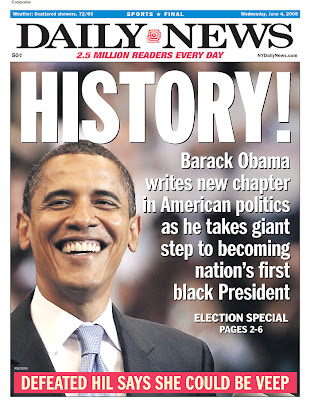
Wednesday, June 04, 2008

AND THE WINNER IS...........


Democrat Barack Obama plunged Wednesday into a five-month election battle with Republican John McCain after making history by becoming the first black presidential nominee of a major US party.

The Illinois senator's giant-killing win over Hillary Clinton came at the climax late Tuesday of the longest, most expensive and spellbinding nominating epic ever.

Dominating newspaper front-pages across the world, Obama declared to 19,000 baying supporters in St. Paul, Minnesota: "America, this is our moment.

"This is our time. Our time to turn the page on the policies of the past," the 46-year-old Chicagoan declaimed, tweaking the Republicans by speaking at the venue of their presidential convention in September.


"Tonight, I can stand before you and say that I will be the Democratic nominee for president of the United States," he said in his victory speech .

Obama's momentous victory , five months since his shock win over Clinton in the very first nominating contest in Iowa, set up an intriguing general election clash with McCain, the 71-year-old Republican senator from Arizona.


On November 4, voters must pick between Obama, a freshman senator and charismatic standard-bearer of a new political generation, and McCain, a wounded Vietnam war hero asking for one final call to service.

Well ahead of the election, Obama has a slight edge over McCain , 46.6 - 45.2 percent, in an average of national opinion polls by RealClearPolitics.com, with their battle already boiling over Iraq, whether to talk to US enemies like Iran, and the ailing US economy.


Both Obama and Clinton were due to address an influential pro-Israel lobbying group in Washington, giving the new presumptive nominee a chance to stake out his appeal for a new diplomacy in the Middle East.

Clinton, thwarted in her own historic quest to be the first female president, refused to explicitly admit defeat and said she would consult with supporters and party leaders "in the coming days" on the way forward.


Failing an outright concession from the New York senator, the Democratic Party's seniormost figures are reportedly set to go public with an appeal to the last undeclared "superdelegates" to declare their preferred candidate.

House of Representatives Speaker Nancy Pelosi, Senate Majority Leader Harry Reid and Democratic National Committee chairman Howard Dean were to release a statement Wednesday urging the party to close ranks against McCain, the Huffington Post website and CNN reported.

"The move ... is an indication that few figures beyond Clinton's utmost loyalists are willing to stomach a prolonged vacation period for the New York Democrat to make up her mind," the Huffington Post said.


Obama, who must now mend his divided party, paid lavish tribute to Clinton as "a leader who inspires millions of Americans with her strength."
"Our party and our country are better off because of her, and I am a better candidate for having had the honor to compete with Hillary Rodham Clinton."


Obama captured the final primary in Montana, after a flood of endorsements from Democratic superdelegates during the day, and vaulted over the winning post of 2,118 delegates needed at the party's August nominating convention.

Obama now has 2,165 delegates to the former first lady's 1,923.

Clinton snapped up a consolation victory in South Dakota's primary, taking 55 percent of votes to Obama's 45 percent. In Montana, Obama had 56 percent to Clinton's 41 percent.


Obama turned his full fire on McCain, saying: "It is not change when John McCain decided to stand with (President) George Bush 95 percent of the time, as he did in the Senate last year."

McCain got his attack in first, branding Obama the "wrong change" for America. On her first campaign visit to New Hampshire, in February 2007, Hillary Rodham Clinton was confronted by a voter who demanded she explain her 2002 Senate vote authorizing the U.S. invasion of Iraq.


"I want to know if right here, right now, once and for all and without nuance, you can say that war authorization was a mistake," Roger Tilton asked Clinton. "I, and I think a lot of other primary voters — until we hear you say it, we're not going to hear all the other great things you are saying."

Clinton replied, as she would repeat in the ensuing months: "Knowing what we know now, I would never have voted for it."

Her refusal to admit error failed to satisfy Tilton, a 46-year-old financial analyst from Nashua even though he loved her position on health care and capping Iraq troop levels.


That exchange, pounced upon by some reporters to the displeasure of Clinton's aides, foreshadowed her demise. Her refusal to back off that vote tied her to the past and to an unpopular war. It embodied her campaign's fundamental miscalculation: the decision to present her as the standard-bearer for Washington experience, ready for office on Day One.


As such it was a telltale moment in the former first lady's dizzying 17-month slide from prohibitive front-runner to also-ran — upended by Barack Obama, a rookie on the national political scene, and by his message of change, in a year voters hungered for change.

By itself, Clinton's Iraq vote didn't cost her the nomination. There were other culprits: her ever-changing campaign themes, poor financial planning, squabbling staff and a field organizing plan designed for quick victory rather than a 50-state delegate hunt.

And there were events along the way that were omens of her downfall — many not fully appreciated in the bright glow of her near-universal name recognition, endorsements from the party establishment and long early lead in the polls.
___
The first quarter of 2007 ended with a big surprise for the Clinton campaign, the reputed powerhouse of Democratic fundraising: Obama raised $25 million from more than 100,000 donors in those three months. While the New York senator had raised $26 million from 60,000 donors, just $20 million was for primaries, $6 million for the general election. Obama's total included $23 million for the primaries.


At first, word of Obama's success led to near-panic within the Clinton team. Eventually, the agitation gave way to a wary calm. "He raised a lot, we raised a lot," spokesman Howard Wolfson mused.

Clinton's money had come largely from squeezing wealthy individuals for the maximum legal contribution of $2,300 for the primaries and $2,300 for the general election. The Obama campaign mined the Internet for small donations from people who could be re-solicited throughout the campaign.


Obama would raise $265 million for the primaries from more than 2 million individuals. Clinton raised $215 million, and would end her campaign more than $30 million in debt. Obama's army of small donors paid for the field organization he would build, drawing on grass-roots support across the country and penetrating states Clinton couldn't afford to contest.
___
In May of last year, a memo from Clinton deputy campaign manager Mike Henry leaked that both foreshadowed and helped produce dire events for her campaign. Henry recommended the New York senator skip the leadoff Iowa caucuses. The document roiled her campaign and revealed the first of many staff disputes. It also would help seal her poor showing in the state months later, which gave Obama a chance to show that white voters would support a black presidential candidate.

Clinton's advisers had fretted about her chances in Iowa. Bill Clinton did not campaign in the state in his first presidential run in 1992, and the couple had never built the organization needed to win the caucuses.

Supporters like former Gov. Tom Vilsack warned that Clinton was starting dangerously late and needed to visit the state more. Campaign people worried that Clinton was sticking to a rigorous schedule in the Senate, not spending serious time in Iowa until late summer 2007.


Although the notion that she wouldn't compete in the campaign's first contest was never considered by campaigns chiefs, Henry had the respect of many in the campaign including top adviser and delegate-hunter Harold Ickes, and he was encouraged to put his concerns about Clinton's Iowa chances in writing.

The leak of Henry's memo — which accurately pointed out that Iowa was Clinton's weakest state and would require a multimillion-dollar investment that might be better spent elsewhere — was a blow that put her on the defensive in Iowa for the remainder of the campaign.

Sure enough, it cost Clinton $25 million to finish third in Iowa — narrowly behind John Edwards but swamped by Obama, whose organizers had identified thousands of young, first-time caucus-goers to come out for him. Henry left the campaign not long after.
___
Clinton delivered strong performances in a long series of televised debates, but that streak came apart in a single moment in Philadelphia in late October 2007, when she was asked during a forum on MSNBC if she would support a proposal by her state's governor, Eliot Spitzer, to allow illegal immigrants to obtain driver's licenses.

"I did not say that it should be done, but I certainly recognize why Governor Spitzer is trying to do it," Clinton said.

That response, and other non-answers that night, made her seem evasive and opportunistic. Media coverage, until then largely respectful, turned critical.
___
Until January of this year, former President Clinton had been viewed as an asset for his wife among her aides and supporters. Although reviled by conservatives for his affair with a White House intern, Bill Clinton remained a beloved figure among Democratic audiences, particularly blacks, who remembered the 1990s as relatively prosperous and his efforts on their behalf.

That changed in South Carolina, where the former president campaigned vigorously for his wife. Her advisers, aware of his tendency to go off message, had urged him to stay positive and talk up her accomplishments, not criticize Obama.

But Bill Clinton chafed at the campaign's reluctance to take on the Illinois senator, particularly over what the former president viewed as conflicts between Obama's rhetoric of opposition to the Iraq war and his voting record. So he took it on himself to speak out, with calamitous results.

Obama won South Carolina, and Bill Clinton then made things worse. He seemed to diminish Obama's triumph by noting that civil rights leader Jesse Jackson, never the presidential contender that Obama had already become, had also won the state's primary years earlier.


Once so popular among blacks he was dubbed the first black president by author Toni Morrison, Bill Clinton had helped drive those voters away from his wife. Obama's already strong black support would climb to as much as 90 percent of the black vote in subsequent contests.
___
Super Tuesday primaries on Feb. 5 looked at first to be a strong showing for Clinton, though not the knockout blow her camp once anticipated.
In fact, a miscalculation about that day propelled her long and steady decline.

Although she won large state primaries — California, New York, New Jersey and Massachusetts — she all but ceded caucuses to Obama in places like Colorado, Minnesota and Kansas. By the final count Obama had collected a few more delegates than Clinton of the nearly 1,700 at stake that day.

Clinton had developed an aversion to caucuses after her bad experience in Iowa; she even publicly called them unrepresentative and undemocratic. Combined with poor budgeting and a poor understanding of the party's system of proportional allocation of delegates, that led to catastrophic strategic planning for the Super Tuesday contests.

When Clinton was still riding high in the polls, campaign chairman Terry McAuliffe, chief strategist Mark Penn and other advisers believed she would come close to clinching the nomination by winning large — if expensive — primary states. The campaign had budgeted accordingly.

Other Clinton advisers had vainly warned that proportional allocation would allow Obama to pick up plenty of delegates in the states Clinton won on Super Tuesday and dozens more in the caucus states if Clinton did not contest them.
Those warnings went largely unheeded and the big-state Super Tuesday strategy failed badly. Clinton's campaign was left nearly broke, with no real plan for how to approach the contests to come. Obama scored 11 straight wins in February alone, while Clinton was forced to lend her campaign $5 million just to stay afloat. He took the overall delegate lead Feb. 12 and never lost it.
___
In March, a self-inflicted wound did more than anything else to undermine her claim of foreign policy experience — and her efforts to reassure voters of her trustworthiness. More than once she personally described coming under sniper fire as first lady during an 1996 airport landing in Bosnia.

"There was supposed to be some kind of a greeting ceremony at the airport, but instead we just ran with our heads down to get into the vehicles to get to our base," Clinton said during a foreign policy speech in Washington. In the hours afterward, her claim was discredited by video of the landing which surfaced on television news and YouTube. But Clinton stuck to her story for a week before finally acknowledging she misspoke. "A minor blip," she called it.


Her aides knew it to be anything but. Privately, they were horrified by the gaffe and saw almost no realistic way to defend it.
___
None of the mistakes by Clinton and her campaign team was fatal in and of itself. She and her husband were experts in extricating themselves from death-defying jams.

But Obama proved to be more than just a traditional opponent. In the end, the Clintons' usual tactics — big-scale fundraising, high-powered political connections, old-fashioned grit and determination — were no match for Obama and a candidacy uniquely suited to the moment.

Campaigning in the final primaries, Clinton said, "I've really enjoyed the process of being able to go out and see this country anew." But what she saw was a country that wanted someone new.


The Democratic presidential nomination his, Barack Obama reached out Wednesday to mend fences with his defeated rival as Republican opponent John McCain tried to frame the fall campaign on his own terms. "I think he has exercised very bad judgment on national security issues and others," McCain said.


Hillary was angling to become Obama's running mate and her aides ramped up the speculation on that matter. "I think a lot of her supporters would like to see her on the ticket," Clinton campaign chairman Terry McAuliffe said. But Obama spokesman Robert Gibbs cautioned "there is no deal in the works."

Clinton has yet to acknowledge Obama's victory in the bruising Democratic race and her aides said on the morning talk shows that she would take a few days to decide what comes next for her. Obama spoke by phone with her Tuesday night and both sides predicted he and Clinton would sit down together before long.

"When the dust settles and it makes sense for her, he'll meet whenever she wants to," Gibbs said. "She's accumulated a lot of votes throughout this country. We want to make sure that we're appealing to her voters."


The primaries behind them, Obama and McCain were drawing the battle line for a fall fight that will make history with the election of either the oldest first-term president in McCain or the first black commander in chief in Obama. In speeches marking the start of the general election, both maneuvered for the advantage with voters sour on the status quo.

Both were competing beyond their party's base, too.

"The key to winning the election is independent voters and Democrats as well," McCain said in an interview shown Wednesday on ABC's "Good Morning America." Even so, he said "I don't think so" when asked on CBS whether he'd pick a Democrat as his running mate.

Saturday, May 31, 2008

SONS OF GOD AGAINST WHITEFACE

Amazon Indians who have never had contact with the world have been spotted in the Amazon’s western jungle near the border between Brazil and Peru. The tribe was sighted in an Ethno-Environmental Protected Area over the Brazilian state of Acre, the National Foundation of the Indigenous People (Funai) said on Thursday.

The tribe was photographed from the air, and images released on Thursday showed tribal members painted bright red, some of them preparing to fire arrows at the aircraft. "These pictures are further evidence that uncontacted tribes really do exist," Survival International director Stephen Corry said.


"The world needs to wake up to this, and ensure that their territory is protected in accordance with international law. Otherwise, they will soon be made extinct," he said.


Brazil's government agreed to release stunning photos of Amazon Indians firing arrows at an airplane so that the world can better understand the threats facing one of the few tribes still living in near-total isolation from civilization, officials said Friday.

Anthropologists have known about the group for some 20 years but released the images now to call attention to fast-encroaching development near the Indians' home in the dense jungles near Peru.

"We put the photos out because if things continue the way they are going, these people are going to disappear," said Jose Carlos Meirelles, who coordinates government efforts to protect four "uncontacted" tribes for Brazil's National Indian Foundation.

Shot in late April and early May, the foundation's photos show about a dozen Indians, mostly naked and painted red, wielding bows and arrows outside six grass-thatched huts.

Meirelles told The Associated Press in a phone interview that anthropologists know next to nothing about the group, but suspect it is related to the Tano and Aruak tribes.

Brazil's National Indian Foundation believes there may be as many as 68 "uncontacted" groups around Brazil, although only 24 have been officially confirmed.

Anthropologists say almost all of these tribes know about western civilization and have sporadic contact with prospectors, rubber tappers and loggers, but choose to turn their backs on civilization, usually because they have been attacked.

"It's a choice they made to remain isolated or maintain only occasional contacts, but these tribes usually obtain some modern goods through trading with other Indians," said Bernardo Beronde, an anthropologist who works in the region.

Brazilian officials once tried to contact such groups. Now they try to protectively isolate them.

The four tribes monitored by Meirelles include perhaps 500 people who roam over an area of about 1.6 million acres (630,000 hectares).


He said that over the 20 years he has been working in the area, the number of "malocas," or grass-roofed huts, has doubled, suggesting that the policy of isolation is working and that populations are growing.

Remaining isolated, however, gets more complicated by the day.

Loggers are closing in on the Indians' homeland — Brazil's environmental protection agency said Friday it had shut down 28 illegal sawmills in Acre state, where these tribes are located. And logging on the Peruvian border has sent many Indians fleeing into Brazil, Meirelles said.

"On the Brazilian side we don't have logging yet, but I'd like to emphasize the 'yet,'" he said.

A new road being paved from Peru into Acre will likely bring in hordes of poor settlers. Other Amazon roads have led to 30 miles (50 kilometers) of rain forest being cut down on each side, scientists say.

While "uncontacted" Indians often respond violently to contact — Meirelles caught an arrow in the face from some of the same Indians in 2004 — the greater threat is to the Indians.

"First contact is often completely catastrophic for "uncontacted" tribes. It's not unusual for 50 percent of the tribe to die in months after first contact," said Miriam Ross, a campaigner with the Indian rights group Survival International. "They don't generally have immunity to diseases common to outside society. Colds and flu that aren't usually fatal to us can completely wipe them out."


Survival International estimates about 100 tribes worldwide have chosen to avoid contact, but said the only truly uncontacted tribe is the Sentinelese, who live on North Sentinel island off the coast of India and shoot arrows at anyone who comes near.

Last year, the Metyktire tribe, with about 87 members, was discovered in a densely jungled portion of the 12.1-million-acre (4.9-million-hectare) Menkregnoti Indian reservation in the Brazilian Amazon, when two of its members showed up at another tribe's village.